December 29, 2020

PV Raji Ashok

PV Raji Ashok 

A BA graduate, Raji's been driving an Uber auto rickshaw since 2014, a month after the company was launched in Chennai. "I started driving auto rickshaws because that was the only means I could find to survive. I used to drive a rickshaw at an auto stand previously, but I had to pay a hefty amount to the association. My husband is a rickshaw driver too. Before Uber, I worked with another ride provider, which did not work out quite well for me," she says. Raji admits that she was initially quite scared about going to areas like North Chennai. "But that's an old story," she says. "I've slowly gotten to understand how safe my city is for everyone.

Raji is originally from Palakkad, Kerala and she fell in love with Ashok, an auto-driver from the village, whom she married later. Although she didn’t go into the details of the struggles the couple initially faced but shortly after getting married, the two decided to shift to Coimbatore. Here, while Ashok drove an auto, Raji worked as an accountant at a travel agency.

However, the couple shifted base to Chennai after the 1998 bomb blasts in Coimbatore that took nearly 60 lives.“The horrific blasts had affected hundreds of people, and we were two of them. We had no option but to restart our lives and so we came to Chennai. My brother worked here in the railways, so we had a strong base to restart our lives on. This change of city brought with it its share of challenges. For one, I could not find a job despite my qualification and experience. After several failed interviews, I decided to start driving an auto for a living just like my husband,”

“Over the past few years, I have given motivational talks in over 13 colleges in Chennai. I also give free auto driving lessons to women interested in joining this profession. This is a great occupation for women, and I want to encourage more ladies to drive autos professionally,”

"I believes that whatever job one does, they must be completely satisfied with it."

December 22, 2020

Shenaz Haveliwala

Shenaz Haveliwala

Shenaz was 19 years old when she had her first seizure and was diagnosed with epilepsy.But that didn’t hold her back. Within a year of her first seizure, Shenaz turned entrepreneur with Sobo Connect, which aims at encouraging entrepreneurs and providing them with working space. She was pursuing mechanical engineering in Mumbai then.

Throughout her journey with epilepsy, Shenaz met people from different cultures, age groups, and financial backgrounds, each with a story to tell. She realized that everyone had his or her own unique problems and epilepsy just happened to be hers.

Two years later she took the very brave step to undergo temporal lobe surgery. During recuperation, Shenaz met patients from different cultures, age groups and financial backgrounds, each with a story to tell. She realized that everyone had their own problem; epilepsy just happened to be hers. This was the catalyst that was to lead to an incredible amount of volunteering work.In 2009, Shenaz collected funds through social networking websites, which she donated to the hospital where her surgery had taken place. The fund helps cover treatment costs of patients with epilepsy who otherwise would not be able to afford it.

In 2010, she started volunteering at the Indian Epilepsy Association. She educates people in Mumbai on epilepsy and campaigns against the stigma attached to the disease. She also teaches members English, basic math and logic. She also interacts with Indian media to highlight the true facts about epilepsy – an invisible disease – and speaks about her life with epilepsy at seminars.

She continues to have seizures and struggles to overcome the side effects of her current medication, but she is happy.  She has learned to visualize the world her way. The following year, despite uncontrolled seizures, she turned entrepreneur.Currently, along with her Masters degree, she is creating a documentary on epilepsy first aid, which can be broadcast in cinemas before the start of the movie and has just begun volunteering with ADAPT (formerly the  Spastics Society of India), as an assistant special educator.In 2013, IBE awarded her as an ‘outstanding person with epilepsy.’Epilepsy has changed me as a person, she says, it has taught me more than any university possibly could.

"I had to stop wondering about the 'whys' in my life and instead focus on the 'hows'"

December 15, 2020

Pradeep Singh

Pradeep Singh

A 22-year-old Pradeep Singh is the son of a petrol pump worker who overcame a lot of hardship and limited resources and cracked the IAS exam. Pradeep who hails from Indore was one of the youngest candidates to appear in UPSC 2018 exams and crack it. His father Manoj Singh originally from the town of Gopalganj in Bihar. Manoj Singh worked as a petrol pump worker and his mother is a housewife.

Pradeep born in 1996 studied in a CBSE school in Indore and then completed his graduation in B.Com (Hons) from IIPS DAVV. Since a very young age, Pradeep was confident that he wanted to be in administrative service. While speaking to The Better India, Pradeep said, “Growing up, I didn’t know what UPSC or an IAS officer was. But my parents often spoke with delight about the success stories of aspirants who had cracked the exams to become ‘afsars’ (officers). I would look on in awe at the joy on their faces as they tried to fathom how proud the parents of these achievers would have felt to see their children crack one of the toughest exams in the country and serve the nation.”

He started his UPSC Civil Services preparation and moved to Delhi. To afford his coaching and accommodation, his father had to sell their home and move into rented accommodation. Determined to make the most of his father's sacrifices and efforts, he focussed on cracking the civil services examination. Hard work paid off and he cracked the examination in 2018 and was offered a position in the Indian Revenue Services.

Determined still, he did not give up and continued to strive for a better rank. In the recently released UPSC CIvil Services 2019 results, Pradeep shined again, finding a spot at the AIR 26 rank. Pradeep preparation strategy involved getting up early, take a shower, eat, and then sit for study. He studied for the whole day and his distractions were rare. He believed that coaching alone cannot help you crack the exam. 

Coaching will contribute about 8-10 percent to the results. But 90 percent depends on your hard work is what he followed to qualify the exam. Presently he is working as an IRS officer.Pradeep Singh is one the IAS Toppers who through his hard work and dedication topped the exam. Know his journey of cracking the exam amid lot of hardship and limited resources.

"What seems impossible is only possible when dedication, hard work, and determination is built together"

December 08, 2020

Dhritiman Bohra

Dhritiman Bohra

It took 17 Years for Diritiman Borah to come up with a product that would make him stand out from the crowd.About 20 years ago,it took a lot of courage for him to tell him academician parents that he wouldnot pursue school beyond class 10 instead ,he started a business making bamboo furniture and kitchen and agricultural implements.

In 2001, Dhritiman just after school started selling Bamboo furniture for a factory. After a while, he thought “Can I do something with Bamboo to replace plastic ? This is when he started his Bamboo mugs/glasses and slowly the idea of water Bottle struck which was just a year and a half ago in 2018. Bamboo Bottle? What a super idea was the people’s response to his innovation. Now he has plunged into manufacturing full time.

Under the umbrella of DB Industries, Dhritiman Borah personally supervises the complete process from start to finish for quality purposes. It takes at least 4-5 hours in making one bottle that involves cutting, boiling, drying, smoking, joining and finishing. He claims that each bottle is 60% hand-made. It's just the beginning and his vision is to replace the plastic industry with Bamboo, Wood, and Jute that is eco-friendly.

Each Bamboo Bottle comes with a unique design because Bamboo itself comes in different shapes and sizes. Design your own bottle concept for corporates with logos etc., is also available with DB Industries.ach bottle takes about five hours to make — from sizing the bamboo, boiling, smoking and drying to make it more tenacious and durable, then joining the parts and the final touches. Boiling purifies and strengthens the wall around the hollow of the culm, and this helps the bottle long.

“Everything is theoretically impossible, until it is done.”

December 01, 2020

Nidhi Goyal

Nidhi Goyal

Nidhi goyal was born on 21 september 1985 is an indian disability and gender rights activist who has been appointed to the un women executive director advisory group.goyal is the founder and director of mumbai based ngo rising flame and works in the areas of sexualitygenderhealth and rights for women and girls with disabilities.She is also the first blind female stand-up comedian in India.

From the age of four, Nidhi Goyal loved to paint, and by the time she was a teenager, she knew she wanted to be a portrait artist. When Nidhi was diagnosed with a degenerative eye disorder, at age 15, the loss of this dream was the biggest blow.

“I’m not sure, looking back now, that I would have had the temperament the patience for it,” Nidhi tells us over a lime soda at a beachfront coffee shop in Malad. Articulate, chatty, and quick to laugh, this through-and-through Bombay girl eventually found a different creative outlet to suit her personality. A few years ago, she turned to stand-up comedy, both as a form of self-expression and as a way to extend the advocacy work she was already doing for disability and gender rights.

“After the first couple of years, when I acquired my disability, I think everything else became laughable,” Nidhi says. With two visually impaired children and one sighted one, the Nidhi family developed its own brand of humour, which treated prejudice not disability as something to be pitied or mocked. “To do comedy,” “you need to be strong enough to point to that elephant in the room, which everyone is pretending is not there. And that’s something I’ve done since childhood.”

November 24, 2020

Sangeetha

Sangeetha

She was a class 9 drop out can proudly say that she has come a long way to achieve her dream in real life. Sangeetha faced so many difficulties in her life. Her alcoholic father abandoned the family when she was a kid.

She grew up seeing her mother and sister working constantly to back the five-member family. Following an eye operation, her mother was left jobless and her sister was only one to support the family. Breaking all the shackles, she steered the Indian football team at the Street Child Football World Cup held in Moscow, Russia, in May 2016.

Sangeetha captained the Indian team in the third edition of the World Cup, which saw the participation of children from 24 other countries.“I dropped out of school in the 9th standard, when I was 13 years old, to help my family. My dad suffered from alcohol addiction and left us long ago. My mum and sister were working to support the family. But we weren’t able to make ends meet.

So I joined a steel vessel manufacturing firm across the street, where we had to melt old vessels, make new ones from the alloy and polish them. The job came with a high risk of Tuberculosis,” she was quoted as saying by the News Minute.

Sangeetha wasn’t someone who delved into disappointment when people said football isn’t meant for girls. But she was one who defied all the odds just like how Lionel Messi dribbles past the players with relative ease. This goes to show that how much passion she has for the game and she didn’t bat an eye what others told about her.

In an interview with dtnext, this bright prospect narrated her life on the street, how football has changed her completely. “People from my street look at me with a lot of admiration. To be honest, I am enjoying this phase of my life. I am glad that they’ve recognised my talent, finally,” she added.

It took Sangeetha’s coach just a few months to understand that she was a natural talent.In her very first tournament, the 'Slum Soccer Gamesa' organised in Besant Nagar, she brought laurels to her team. At that time, she represented Karunalaya’s girls team. The team won the tournament and Sangeetha brought home the Best Player award.

From here, there was no looking back.In 2016, she was the only player from Tamil Nadu to be selected as part of the squad representing India in the Homeless World Cup held in Glasgow, Scotland.

"They told us only a few months before the tournament and I was besides myself with joy. It was the first time I went outside Chennai, my first time in a flight and my first ever trip abroad," smiles Sangeetha.

Following this, she was selected to represent India in the 2018 Street Child World Cup in Moscow, this time as captain - an achievement that made her the pride of her street.

"We won against Mexico and I scored one goal in our game. We gave it all we got," she says.Sangeetha's strength is her level of fitness, says her mentor and street co-ordinator Vasanth, who works for Karunalya.

"I didn't have a birth certificate or an address proof to show. We only had a Voter's ID. So it was difficult to get a passport as they said that I need to show them a permanent address to get one. We don't have a permanent address. This street is my address. This is when Karunalaya director's intervened and helped me get my passport and visa for Scotland," Sangeetha says.

November 17, 2020

Jyoti

Jyoti

Soberan, then 30-years-old and a bachelor, was returning home after a hard day’s work as a vegetable seller.he suddenly heard a baby’s cry in a distance and went to investigate. To his shock he found a tiny tot a baby girl lying on the heap of garbage.

Soberan looked around to see if the child’s mother was around, and finding no one, decided instantly that he was going to rescue the child and bring her up as his own. A very daring decision indeed but he was steadfast on doing it.

It was an infant girl. Soberan brought her home.Soberan was 30 years old at that time and was not even married. Soberan was very happy after finding that girl. He decided to raise her and not marry.Soberan named that girl Jyoti.Soberan thought he should work hard day and night and did not let her feel the lack of anything. He sent her to school and did everything he could to fulfill her needs.Even if he had to remain hungry, he never let his daughter fall short of anything. 

Years passed by….., and Jyoti graduated in Computer Science in 2013. She started preparing for competitive exams.In 2014, Jyoti performed brilliantly in the examination conducted by the Assam Public Service Commission and was appointed the Assistant Income Tax Commissioner.

Soberan got wet with tears after seeing his daughter  fulfilling all her dreams.At present, Jyoti is taking good care of her father and is fulfilling all his wishes.Even though she insists on his relaxing at least now, her father still runs the vegetable vendor trade.Soberan says,” *I did not pick a girl from a garbage, instead, I got a diamond from a coal mine, which filled my life with divine light*.”

"Don't tell everyone your plans, instead show them your results"

November 12, 2020

v kathiresan

v kathiresan
Dr Kathiresan lost his father very early in life and had to support his family. Though he was always fond of studying, financial problems compelled him to drop out of school. “It was one of the most painful decisions of my life, but I accepted it as a way of life.” He trained as an electrician and joined the Indian Army in 1979. His first posting was in Bhopal, then Sikkim, followed by Hyderabad. He first met A.P.J. Abdul Kalam at the Defence Research and Development Laboratory (DRDL), Hyderabad, in the 1980’s. Kalam was the director at the time and Kathiresan was deputed as his driver. Kathiresan caught the former Indian President’s attention when Kalam saw him reading newspapers, magazines and books. It was then that Kalam encouraged and motivated him to study further.

“I must thank the Almighty that I was given such an opportunity,” says Dr Kathiresan. “If not for Kalamayya’s inspirational words, I would have never been able to achieve this. Even after Ayya left DRDO, I continued to ponder over what he said about the importance of education.”

With the help of Dr Kalam, Kathiresan learned English, the subject in which he failed in his Class X. He reappeared for his Class 10 exams and cleared his English paper. He then appeared for the Class XII examinations and went on to obtain a B.A. (History) from Madurai Kamraj University through distance education. He later completed an M.A. in Political Science.

This school dropout, who used to work as a driver for A P J Abdul Kalam, ensured that his dream turned into a reality at the age of 47.

A native of Vadachennimalai in Tamil Nadu, Kathiresan has come a long way with sheer determination. From being a school dropout, he went on to complete a PhD in history and was appointed a lecturer at the Arignar Anna Government Arts College in Vadachennimalai last year.

"I can never forget the role played by Kalamayya (sahib). I worked as a driver with him for five-and-a-half-years and during those long drives, I used to talk to him about my aspirations and dreams."

"One day while driving, Ayya suggested that I should resume my studies. He told me that the best way to go about it was through long distance education. Ayya used to lecture several students about the importance of education. I used to listen to him speak and got inspired."


"Anything is possible or shall we say nothing is impossible"


November 03, 2020

subhreet kaur ghumman

Subhreet kaur ghumman

Subhreet Kaur Ghumman was born on 22 April 1986 is resident of jhundan village, amargarh, sangrur district in punjabI am fond of dancing since my childhood and my Mom did her very best in motivating me and I was back on dance floor in less than a year after my accident. I am blessed to have a brother and a sister as my best friends too; I lost my Father when I was 13 years old.

I have done my BSC in Nursing and Cosmetology, now I am a make-up artist.I won’t pretend my life is easy, but through the love of my Mom, loved ones, and faith in God, I have overcome my adversity and my life is now filled with joy and purpose. I reside now in Punjab, India with my Mom and we both love seeing people’s lives changed for the better or touched in some way. 

On 21st October 2009 I met with an accident and got a fractured leg. Doctor never realized that I got AV (Arteriovenous) Malformation in my leg few days after he operated. On 5th November 2009 I was again operated for the AV Malformation but during the operation there was excess bleeding due to which I slipped into partial coma and the doctors declared me dead. 

Then another set of doctors took over, they were able to stop the bleeding but during the procedure my sensation nerve was damaged which eventually resulted in amputating my left leg above knee and after 6 months I got my prosthetic limb.

She saw Vinod Thakur dancing on television and decided to start dancing on one leg. Shubh started practicing daily. She continued her passion for dance and she lived according to her life's motto, "Never give up..... Nothing is impossible,". Her mother Smt. Charanjeet Kaur is her role model.Shubh got selected in India's Got Talent TV show for her dance performance.

Her performance received a standing ovation from the Judges. Salman Khan admired her on Twitter "Wah Yaar. Hats Off. Kamaal Hai." In 2015, she became a contestant on Jhalak Dikhhla Jaa (season 8) and was impressed by the judges. She was eliminated in week 6.She married Yash Makkar. After two months of marriage she charged her husband with sexual harassment. Her husband claimed that she was demanding a huge amount for divorce but it was not so. He claimed everything wrong about her. She lives with her mother now and left her husband.


"Never give up..... Nothing is impossible,"

October 27, 2020

Natalia Dorota Partyka

Natalia Dorota Partyka


Natalia Dorota Partyka was born on  27 july 1989.The 23-year-old was born without a right forearm and has to carefully balance the ball in the folds of skin at the end of her elbow before dropping it on to her swishing bat.Partyka began playing table tennis at the age of one to seven years.


For me, it (disability) is nothing, she told reporters after losing her third round match to Netherlands Jie Li. I am playing the same lines as the others. I am doing the same exercises.I get a bit bored about being asked about disability all the time.She is happy, however, if her achievements act as an inspiration to others.Maybe someone will see me and realize that their own disability is not the end of the world, she said.

Maybe someone will look at me and think they can achieve something bigger than they thought. Maybe sometimes you have to work a little bit harder if you really want to do something. If I’m an inspiration I can’t complain.

She won her first international table tennis medal in 1999 at the disabled World Championships. At the age of 11, when she competed at the 2000 Summer Paralympics in Sydney, she became the world's youngest ever Paralympian. In 2004, she won a gold medal in the singles event and silver in the team event at the Athens Paralympics

Also in 2004, she won two gold medals at the International Table Tennis Federation's European Championships for Cadets, which was open to able-bodied competitors. In 2006, Partyka won three gold medals at the European Paralympic Championships, one gold and two silvers at the International Paralympic Committee's Table Tennis World Championships for Disabled, and a silver in the team event at the ITTF European Junior Championship. 

She also won two silver medals and one bronze at the 2007 edition of that competition. Also in 2007, Partyka won three gold medals at the European Paralympic Championships, and a bronze at the ITTF World Junior Teams Championships.

"We have the same goals and the same dreams and I can play like them. I can serve and don’t have any problems."

October 20, 2020

Bharat Kumar

Bharat Kumar


Bharat Kumar was born  Dec 10, 1989  with a right hand by birth, but his physical disability never dissuade him from pursuing his dreams. a world champion, has made Bharat (India) proud by winning over 50 medals in para- swimming contest.But if we scratch the silver lining, then his life is full of heart-wrenching hurdles. Even after achieving the feat and turning odds in his favour, poor Bharat's contribution in making India proud has been sadly ignored.

Today, he is forced to wash cars to make his both ends meet and situation has come to the point that he may have to sell his hard-won medals to earn money.Like Cricket star Virender Sehwag and national level wrestler Sushil Kumar, Bharat is also a native of Haryana (a state that has given many sports-persons to this nation) and lives in south-west Delhi's Najafagrh area, in a small house.

His old parents are daily-wage labourers, who dig soil. He has three younger brothers to take care of and his two sisters are married.Bharat, who was born and brought up in a poverty-stricken family learnt swimming by holding the tail of buffalo! Swimming became his passion in 2002 and formally started practicing in 2004 at Delhi Jawaharlal Nehru Stadium.

He says that at least Rs 20,000-Rs 25,000 are required per month to take proper training and nutrition requirements. But he has no-one to sponsor for his training.27-year-old Bharat and his family have ran from pillar to post to the concerned authorities and to Delhi government, but their repeated pleas fell on deaf ears.

As part of mementos, his medals and his photographs with former Haryana CM Bhupinder Singh Hooda, MDH owner Mahashay Dharampal Gulati, and other bigwigs are decoarted on the walls of his room.

October 13, 2020

Deepa Malik

Deepa Malik


Deepa malik was born on 30 September 1970 is an indian athlete.mother of two, she created a special bond with her elder daughter devika, who also developed an impairment at an early age. When deepa was again diagnosed with tumours, which ended up in the surgery that left her paralysed from the waist down, Devika began presenting the symptoms of hemiplegia that limited the movements on her left side. “Just as I was getting used to bringing up Devika with her challenges, I was myself bedridden. I was learning my new body. Somewhere I felt maybe destiny got me to this, to be a role model for my child to exercise.” Years later Devika even represented India in international Para athletics competitions. “In our house, whenever there's cooking, it's family time. 

Deepa Malik is the first Indian woman to win a Medal at the Paralympics. She won silver medal in the shot put at 2016 Paralympic Games. She was previously honored with the Arjuna award in 2012, at the age of 42 years.

She has also been conferred the prestigious Padma Shri award in 2017. She created a New Asian Record in Asian Para Games 2018 and is the only Indian woman to win medals in 3 consecutive Asian Para Games (2010, 2014, 2018). She has won 58 national & 23 International medals across all disciplines to date.

She is a member of the working group in the formulation 12th five-year plan (2012–2017) on sports and physical education as nominated by the Planning Commission HRD Division on behalf of the Sports Ministry. She is also the 'Clean India' brand ambassador for NMDC and expert consultant for Disability Inclusive Accessible Infrastructure for Ministry of Housing and Urban Affairs 'Smart Cities' project.

" People will always look at you the way you look at your self "

October 06, 2020

Shekar Naik

Shekhar Naik


Shekhar Naik was born on 7 April 1986.Naik was born in Arakere in southern karnataka as the son of a farmer. He was born completely blind, and his mother and 15 members of his family also suffered from visual impairment. Naik injured his head after falling down along the bank of a river when he was seven.

He was taken to a health camp organised nearby, and during the treatment the doctors realised the possibility of restoring sight in his right eye. He was subsequently operated upon in Bangalore and was able to get 60% of his vision in his right eye.His father died soon after, and he was sent to the Shri Sharada Devi School for the Blind in Shimoga. He learnt to play cricket while at the school.

 He worked in the fields during the summer holidays to fund his cricketing ambitions. His mother died when he was 12. While not playing, he works as a sports coordinator for an NGO called Samarthanam, which funds the Cricket Association for the Blind in India. He has two daughters.

 Naik is now stepping into a new venture. He has kick-started the Shekhar Naik Foundation, a sports academy exclusively for aspiring blind cricketers! Naik claims that his new academy is the first of its kind in India.This sports academy was inaugurated on 11 November, and is located at Shimoga in Karnataka. 

It was inaugurated by Ashok Naik who is the MLA of Shimoga. Shekhar Naik Foundation already has 25 youngsters enrolled for training. There are 15 school students and 10 adults of different age groups who are now part of the venture. All of them belong to the southern part of Karnataka.

September 29, 2020

ANJALI SRIVASTAVA

ANJALI SRIVASTAVA 

Anjali Shrivastava, a student of the Ashoka Institute of Technology and Management, hopes that the 'Robo Helmet' will surely prove to be a revolution in terms of border security."The Robo Helmet will prove to be a revolutionary invention for security forces. It is specially designed to strengthen troops. However, it is a prototype right now, but we have sent a requisition to the Ministry of Defence so that we can make it more powerful," she said.

The light-weight, remote actuated helmet is capable of moving 360 degrees. The prototype version can be operated through remote within a range of 50 metres while the gun in it can fire up to 100 metres.Shyam Chaurasia, in-charge of Ashoka Institute of Technology and Management, said they had prepared the prototype of the 'Robo Helmet'.

Senior scientist from Regional Science and Technology Centre, Mahadev Pandey said that it's a good invention and can prove really helpful for the soldiers adding that the DRDO (Defence Research and Development Organisation) should analyse and encourage such inventions to realise the 'Aatmanirbhar Bharat' dream.

she also designed a pair of pants outfitted with a small electronic button that sends a distress call to the nearest police station when pressed. The signal also acts as a tracker, so that police can rush straight to the victim’s location.

Anjali made the helmet inspired by PM Narendra Modi’s Atmanirbhar Bharat slogan. It took her 15 days to make the helmet. The average cost of each helmet is 7000-8000 INR.

September 22, 2020

Harshwardhansinh Zala

Harshwardhansinh Zala

Harshwardhansinh Zala looks like any other teenager however, what sets the 15-year-old tech freak apart is his latest innovation: A drone that can detect and detonate landmines. “We’ve developed a technology called multi-spectral detection to identify metal and plastic landmines, unexploded ordnance and improvised explosive devices. 


We can detect explosive devices, track their location and detonate them with our wireless detonator, averting any human risk,” says the inventor from Ahmedabad, animatedly with a furrow on his forehead.Developed over three years, EAGLE A7 (Escort for Attacking on Ground & buried Landmines as Enemy by Aerobotics7) is a battery-operated, 555-mm wide quadcopter drone. It has an accuracy rate of 91-93 percent, claims Zala. 

Built using a 3D printer, the device can detect landmine explosives and send real-time data to a ground control station (see graphic). The drone is also equipped with a light-weight wireless detonator (developed in-house) to blast the landmine. Zala is working on filing five international patents for his technology.

“This tech is not available anywhere else. It has multi-spectral land mine detection technology which can detect mines,” Zala, told ANI about his invention.Zala has also received many offers from abroad, however, he wishes to help the armed forces through his tech. “I’ve received many offers to go and work abroad but it is my wish to develop this drone and deploy it to serve the Indian Army and CRPF, to save our jawans from being martyred,” he said.

September 15, 2020

ira singhal

ira singhal

Ira singhal was born on 31 August 1983 in Meerut to Rajendra Singhal and Anita Singhal.Her father is an engineer and mother is an insurance advisor.Ira has scoliosis, a spine-related disorder, which disrupts her arm movement. She completed her schooling from the Army Public School, Dhaula Kuan and studied Computer Engineering from Netaji Subhas Institute of Technology and received Dual MBA in Marketing & Finance from Faculty of Management Studies, University of Delhi. 


Singhal topped the exam in her fourth attempt, to become the first differently abled woman to top the civil services exam in the general category.After MBA, before appearing for Civil Services Examination in 2010, she worked as a Strategy Manager in Cadbury India and as marketing intern at the Coca-Cola Company. She has also taught Spanish for a year.


She is the Brand Ambassador for Department of disability, ministry of Social Justice and EmpowermentGovernment of India. She is also one of the brand ambassadors for Ministry of Women and Child Development & NITI Aayog and is on the National Panel for Accessible Elections, Election Commission of India . She has also been a part of the Designing of Central Board of Secondary Education (CBSE) Examination Policy with regard to children with disabilities .

She has been a speaker on wide-ranging issues like educationdisabilitygender issues, skill development, career counseling, etc. at more than 500 international and national conferences, industry forums, universities, colleges and other top institutions of the country including IIMs and IITs. She has been working towards various social causes including empowerment of persons with disabilities, empowerment and promotion of Transgender community, women empowerment, prevention of child labour and child marriages, prevention of illegal conversion of green lands, promoting green energy, skill development, promotion of mental health and promotion of khadi and indigenous fabrics. 

"Every one wants choices for themselves ,But we are so afraid of letting others have their choices"

September 08, 2020

Girish Sharma

Girish Sharma

Sharma was born in Rajkot to an Indian Railway Employee and transferred to Gujarat with his parents. He lost his leg in a train accident at the age of 2, between rails and amputated.Girish, a permanent disable from India plays badminton which is an impossible task for a person with only one leg. He had many records to his credit under the disable categories. He played Paralympics Asia Cup for disabled, held in India and won a gold cup. He played in Israel and Thailand and other countries representing India. He also ride bike like any other ordinary man.

He had a sad story to narrate about his decision to go for badminton as a handicap. reports say that he loved a female and she insulted him with harsh comments on his disability. This triggered the inner powers in him, a burning want to prove that he is not a handicap and like another normal man can take hard sport and win. He chose badminton as his life career because badminton is a tough game and requires a lot of sills and energy. His decision paid him dividends.

This is a true inspiring story to lazy youngsters. With all body functions normal many youth are getting addicted to bad habits and loosing their stamina, strength and energies. If a percentage of our young Indians population explore their energies for the welfare of the India, we will always see a victorious India. All god medals in Olympics, Asian games will be ours.


The hardship has taken a toll on him, but winners never quit! Girish does not want to stop at just stop at medals he wants to improve the sports reforms, especially for the physically challenged. He wants to disabled sports quota, to this end and help the aspiring sportsmen.

"My disability was nowhere near in my mind. I enjoyed all situations as much as a normal person does.” What a spirit!"

Search Results

Featured snippet from the web

September 01, 2020

Mohammed Gaddafi

Mohammed Gaddafi

Mohammed Gaddafi, who lost his legs at the age of 19, along with his friend Balaji, started Maa Ulaa in Chennai. The startup is India’s first bike taxi service run by the differently abled.
In a country where a job is difficult to come by for differently-abled people, few of these men and women decided to make a difference by starting a bike taxi service in Chennai- Ma Ulaa.
‘Maa’ is for ‘maatru thirunaaligal’ meaning ‘differently abled’ and ‘ula’ translates to ‘journey’– which means ‘a journey with the differently-abled’.
Recalling how he got the idea, Mohammed said, “I saw a differently abled person on his tricycle at Marina Beach one evening. He parked in a corner and started begging. I was shocked, but when I spoke to him, he asked, ‘How can we lead better lives just because the government has provided bikes?’" Mohammed, who has a PhD in history, has been a professor at Presidency College and has worked at two private firms.

The idea took shape when the founder of this bike-taxi service K Balaji was aided along by his friend and co-founder Mohammad Gadaffi, who gave the service its name- Maa Ulaa.

It was K Balaji (36) who gave up his job of making power-point presentations in a small company and kept himself busy by riding to meditation classes in the evening. One thing he hated was people sympathizing and pitying him for being differently-abled.

Currently, there are 30 bike-taxi drivers in Chennai and 25 drivers in Tirunelveli who are associated with Maa Ulaa. They charge Rs.25 for the first two kilometers and Rs.10 per kilometer beyond that. While the base fare remains same, the night charges are Rs.15 per kilometer. According to the figures mentioned on their website, on an average, the drivers can earn Rs.25,000 per month.

"This wonderful initiative by the specially-abled people tells us a lot about the tenacity and grit with which a human mind can work"

August 25, 2020

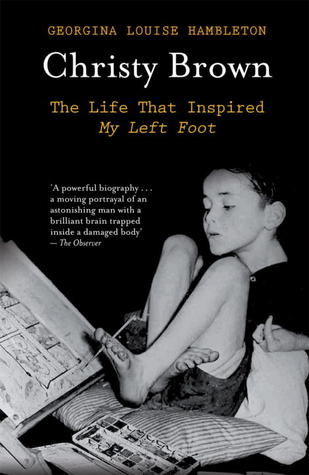
Christy Brown

Christy Brown

Christy Brown was born into a working-class Irish family at the Rotunda Hospital in Dublin in 5 June 1932 who had cerebral palsy and was able to write or type only with the toes of one foot.Brown's parents were unswayed and subsequently determined to raise him at home with their other children. During Brown's adolescence, social worker Katriona Delahunt became aware of his story and began to visit the Brown family regularly, while bringing Christy books and painting materials as, over the years, he had shown a keen interest in the arts and literature.

Christy Brown painted habitually and read frequently, mostly 19th century and early 20th century novels. He was later able to improve his muscle coordination and speech through therapy.

Christy Brown: The Life that Inspired My Left Foot by Georgina ...His autobiography, My Left Foot, was expanded into the novel Down All The Days in 1970, and went on to become an international best-seller. Two lesser-known novels followed, A Shadow on Summer and Wild Grow the Lilies, as well as three books of poetry.

Christy Brown died on September 7, 1981, at the age of 49, in Parbrook, Somerset, England. Seven years later, his autobiography was adapted for the big screen; directed by Jim Sheridan and released in 1989, My Left Foot starred Daniel Day-Lewis as Brown and Brenda Fricker as Brown's mother. Both actors won Academy Awards for their performances.

August 18, 2020

Shakuntala Devi

Shakuntala Devi


Shakuntala Devi was born in bangalore karnataka on 4 november 1929 to a kannada brahmin family.Her father worked as a trapeze artist, lion tamer, tightrope walker, and magician in a circus. He discovered his daughter's ability to memorize numbers while teaching her a card trick when she was about three years old.Her father left the circus and took her on road shows that displayed her ability at calculation.She did this without any formal education.

At the age of six she demonstrated her arithmetic abilities at the University of Mysore.In 1944, Devi moved to London with her father.She was an Indian writer and mental calculator, popularly known as the "Human Computer". Devi strove to simplify mathematics for students.

Her talent earned her a place in the 1982 edition of The Guinness Book of World Records.However, the certificate for the record was given posthumously on 30 July 2020, despite Devi achieving her world record on 18 June 1980 at Imperial College, London. 

Devi was a precocious child and she demonstrated her arithmetic abilities at the University of Mysore without any formal education.Devi wrote a number of books in her later years, including novels as well as texts about mathematics, puzzles, and astrology. 


She wrote the book The World Of Homosexuals, which is considered the first study of homosexuality in India.She saw homosexuality in a positive light and is considered a pioneer in the field.Notably, the first woman mathematician in India, Shakuntala died in Bangalore on 21 April 2013 at the age of 83 due to cardiac and respiratory problems.


"Numbers have life; they are not just symbols on paper"